Sunday, February 25, 2007


The Opium of the People


Thus far in Asia the Laos people are without doubt the most gentle that I have come across. I am convinced however that a large part of this uncorrupted goodness is not necessarily down to their Laotian genes but due rather to their Buddhist creed that seems to pervade every facet of their daily lives.

Of course this said religious consciousness is made all the more evident by the omnipresence of Buddhist monks with their shaven heads, bare feet and orange robes. Indeed nowhere has this been more so the case than in Luang Prabang, second city of Laos. However what makes it all the more interesting is the fact that the ruling communist government of "The Popular Democratic Republic Lao" which came to power in 1975 had made it their mission to oppress the Buddhist religion until as late as 1992. Did the powers that be soften or was it the realization that their efforts were in vain? I have no idea. Nonetheless while the Laos socialist experiment embraced the market economy in the 1980's, freedom of religion did not return until the nineties, just in time for the opening of their borders and the birth of a vital tourism industry. Incredibly nowadays the very same undemocratic government has absolutely no qualms about filling their tourist publications with image upon image of Buddhist temples and waxing lyrical about their monks and monasteries. Still and all, what is important is not the motive but rather the fact that the people have their beloved religion back and I might add, as strong as ever.

The form of Buddhism practiced in Laos and the surrounding territories is known as Theravada Buddhism which remains unchanged and true to the founding principles which date from the time of Buddha (483BC). Of course as with any religion it would be impossible to fit the essence of the faith into a few paragraphs. Suffice to say that the ideal situation is to reach “Nirvana” without going through reincarnation. It follows therefore that a core belief is the concept of rebirth and one’s direct influence on one’s future lives. Likewise our own past actions are the causes of what we experience now, meaning that every daily action has an effect on our future. Perhaps it is from this that stems their soft nature and enthusiasm which I little deserve but which fascinates me so much.


“Merit” is what we accumulate in past lives and the merit earned in the present life has a bearing on our fate. Judging by my experiences to date it seems to me that the faithful are forever conscious of the merit they have earned. However while that may be so, “intention” is the key and the degree to which the action is performed for purely selfish reasons, the merit earned will be correspondingly less. So perhaps I am wrong after all as there can be no fooling Buddha! Maybe the kindness really is genetic.

Much like the rules under the Kyoto protocol, credit can also be transferred or better said, dedicated to loved ones including the deceased. I am told that in fact this is more often than not the practice. For example when a man temporarily becomes a monk be it for 1 week, 3 months or even years, this accumulates merit for his mother and father, living or dead. Notably, doing so for the deceased is considered to be of utmost importance as the departed spirits are no longer in a position to gain merit for themselves. In Laos and apparently in Myanmar, all Buddhist males temporarily ordain as monks at least once in their lifetime. In Northern Thailand I spoke to a 29 year old cyber café employee who has already done so 3 times.

At 5 am every morning in Luang Prabang well over 1000 monks set out in single file from their respective monasteries, each armed with a large empty sphere-like “alms bowl”. It appears that every temple has their own regular trail although given the size of the town parts of the route are shared with other monasteries. This certainly makes for the most spectacular sight on a typically misty Asian morning when up to 3 orange battalions converge at crossroads in perfect silence. The purpose of the alms round is for the monks to collect food from believers who stand sleepy eyed outside of their homes. Many, invariably a female, get up before sunrise to prepare the food though nowadays in a fast changing society there are some who buy the same pre-packaged offering such as sticky rice (a morning favourite) , curry, soup, spices or even milk. However in true fairness all is not dumped into one alms bowl but rather a fistful or similar of food is placed into the bowl of each monk as he files by. The popular practice of providing grub for the monks is held in very high regard in terms of “merit making” as in assisting the monks one is helping to ensure that the Buddhist teachings live on. This daily food round by the monks is not at all looked upon as begging but rather that theirs is a charitable act in that they provide laypeople with the opportunity to make merit for themselves.

Coming from an Irish or Spanish society that until recently had little or no experience of the non Christian faiths, it is understandable that Buddhism might be a difficult one to grasp. However as one American monk put it to me,

“Merit making is simply an effort to make the world a better place, that honour the dead and that preserve Buddhism for future generations."

I can’t really argue with that now, can I?

Saturday, February 10, 2007


Slow Motion on the Mekong

It seems that everybody has a different version on how to best cross each respective border in South East Asia. In this regard that of Thailand-Laos is certainly no exception and I quickly found that not only is it a moot topic in hostals but indeed few paper or cyber guides seem any more capable of reaching proper agreement on hte subject.

In the end with the border lying in the middle of the Mekong, it was simply a matter of stamping out on the Thai river bank, catching a half sinking timber taxi across the river and being stamped in by the foreign officials on the opposite waterside. That is of course not forgetting the 31 US dollars payable for a Laos tourist visa plus the 1 dollar bribes due to guards on both sides as a show of our appreciation for their having turned up for work in such depressingly uneventful and grey border towns. However depite my excited enthusiasm I quickly realised that there was little of interest to me in this odd Laos hamlet of Huay Xia and decided to buy a ticket for the slow boat that would eventually take me down river to Luang Prabang.


On climbing the bamboo gangway it became immediately clear that all seats were already taken and so I was ushered aft to the engine room where they kindly provided me with rice sacks to sit on. To my great surprise I actually wasn't the last to board and with all fixed seats and rice bags occupied, the ever resourceful teenage sons of the boat owner ran up to a local bar and borrowed the red plastic garden chairs that were stacked outside. Soon with temporary chairs also becoming a scarcity, 2 hammocks were then hung above baggage and rugs were rolled out on the floor for the late arriving hill tribe people. The truth is that there was nothing comfortable about the boat and I could hear many foreign travellers despair that this was the low point of their trip. Watching these very people helped the hours pass by quickly as it suddenly dawned on them belatedly that yes! they are on a river in Asia and no ! they are not cruising down the blue Danube.


The naked engine looked much like that of a present day Cuban Cadillac. And as if that was not enough food for my senses, my travelling space was noisy with both walls and floor vibrating around me. But who cares ! I had the best seat on board where I had locals offering me sticky rice and smoked buffalo instead of everest clad Germans teasing me with their Sour Cream and Onion Pringles. I reckon that the official capacity of the boat was about 70 people and that we must have being carrying upwards of 200 passengers plus baggage. As a result the boat sat a good deal lower in the water with the long dead shipwrights surely turning in their graves.


Travelling down the Mekong whose sourse lies in Tibet and on whose waters almost 60 million lives depend, were for me the most fascinating hours that I have spent in South East Asia to date. Incredibly it was not at all unusual to spot Elephant being used for logging (illegal in Thailand) , wild Buffalo grazing or even crouched families washing their clothes, themselves and their dishes. Unfortunately I never saw any wild Indochina Tigers although there are said to be about 500 remaining in the Laos wilderness (compared to 100,000 a century ago). More than once I smiled to myself as the thought came to me that I was starring in a National Geographic documentary. My brain was simply not accustomed to such sights without the 15" frame of a televison set.


However when not scanning the Mekong menagerie I also had the local Mekong teenagers to amuse me. Being the foreigner with the big camera , 2 groups of Laos adolescents used me as a means to show off to their counterparts, often insisting on posing for photos as an excuse for some futher tactile flirtations. Other times they would humorously doze off pretending to be unaware that their feet were tangled or touching. However my draft of "Romance on the Mekong" would never have captured the worlds imagination as did "Murder on the Nile", so I turned my attention back to the muddy waters speeding by and some of the curious crew members.


My favourite character was a smiley crew member who every hour or so would whisper "ganja" into my ear as he tried to make a few bob more by peddling drugs on the vessel. On declining his offer his smile would simply broaden three fold under his peek cap before trying his luck with a loud whisper of "opium" or "cocaine". Then he would laugh, wink and disappear off out the window for another short bare foot wander on the roof.

Nine hours down river we finally reached the absurd pirate town of Packbeng where we were to stop for the night. In the absolute darkness it was a race against local kids to retrieve your bag from the boat before they would haul them up the steep and rocky incline and insist on charging you a dollar for their uninvited help. Neither the riverside nor the town were very well lit and we had to be guided up to the town by locals owing to the town generator being switched off at 9pm each evening. However as soon as we reached the beginning of the settlement we were accosted by locals touting overpriced accomodation for the night. Cold and tired my first line of inquiry was about the availability of hot water, to which they replied "No hot water, but lots of Opium!" The village in its entirety consisted of only one surfaced street and even now the settlement was best accessed by river. The place had a peculiar charm about it with a most majestic location high above the mighty Mekong. It is possible that it's very existence and function stems from the fact that it is very far from everywhere and has always offered shelter to weary travellers making their windy way down stream.


And so the next morning it was back on the river for another day of slow motion. Yet again as we pulled away we could see kids riding elephants as they hauled the logs onto the waiting barge. Meanwhile the nearby crane remained ominously still and unmanned. All along the river throughout the day Bamboo sticks were lodged between rocks and hanging out over the brown coloured river. These were all fishing rods, obviously tended to late each evening before night fall. At other times the boat would pull over to the bank in the middle of nowhere without a house in sight where someone would eventually hop on or hop off before a bag of rice (size of a large bag of spuds) followed over after them. Other times we would stop in order to allow women and children board and sell anything from tamarinds and bananas to Beer Laos and peanuts.

On the second evening after a total of 20 hours on the river boat, 17 hours of those involving actual motion, I arrived at my end destination. Happy and exhilerated by the trip but still delighted to have my feet on terra firma and finally climb the steps up into "the Jewel of the Mekong", Luang Prabang.

Sunday, January 28, 2007


Ko Sahn Road

It is slowly dawning on me how much I actually dislike quite possibly the stangest tourist location that I have ever visited.

Ko Sahn Road is the infamous flea market street in Bangkok where anything goes and everything is sold. Prostitutes, coconuts, milkshakes, papaya salads, ladyboys, airline tickets, massages and even mosquito nets are all engaged in one big and aggressive price war. It all just depends on the apetite or need of the individual.

The truth is that Ko Sahn Road is nothing more than a stop over where everyone is in transit, be it the beginning of their journey or exhausted end. At current prices a room, complete with cardboard walls and solid, piss proof mattress, can cost anything in the region of 150 to 500 baht (100 baht = 2 Euro). Does it possess any charm? No. Can you relax and chill out? No. In other words while it may humour you for a day or two as you sit people watching until your visas are processed, you breath a big sigh of relief when you finally head due north or south and out of the metropolis.

In my case, after intense revelling and outdoor activity in New Zealand, Bangkok and Ko Sahn Road provided me with the perfect opportunity to catch up on badly needed sleep and recharge my batteries. In the mornings I was happy to wander out to the more local areas and get a taste for Urban Asia but after a few hours I was more than ready for some spicy TOM YAM soup followed by an indulgent siesta with of course some badly acted and hysterical Thai sopa opera muffling out the choas bellowing up from the street below.


In my mind Bangkok will most definitely always be associated with a bad smell, annoying omnipresent images of the god-like King, an entire public dressed in yellow as a show of support for monarchy and coup, and last but not least the motor bike taxis(Tuk-Tuks) who forever try to dissuade you from visiting the Emerald Buddha or Grand Palace and instead splash out on a "special massage" with some Thai business ladies.


Bangkok is a city just like any other. It is big, noisy and in Thai terms, expensive. There is much to see but I now realise that it is nothing that cannot be bettered in the villages and countryside.


Wednesday, January 24, 2007


New Zealand


While the Euphoria of the Lord of the Rings may have been completely lost on me I had on many occasions seen the Haka, marvelled at Jonah Olomu and of course pretended to be surprised each time a person compared the landscape of New Zealand to that of Eire. I was also vaguely familiar with proper nouns such as Christchurch, Auckland, Wellington and Maori but unfortunately that is as far as it went. I am however at long last proud to to say that not only I have finally cured my ignorance all things Kiwi but I am also suddenly very sad to have to leave it all behind.

For all of my time here I was based on the South Island where I am told only about 30% of the population live. Indeed you certainly grow to love this place as you become more and more accustomed to that extra bit of elbow room allowed to you. As you might guess given the rural nature and unpopulated landscape it was easy to see very quickly that the principle industry in thses parts is agriculture and more specifically dairy, sheep and deer farming, the last of which is in considerable decline in recent years. However the size of the farm is like nothing I have ever seen with two of the nearby "stations" milking upwards of 700 cows daily. As you might guess this is for the most part automated with the cows stepping on and off the revolving "merry-go-round like" milking platform. Meanwhile the preferred vehicle is understably the UTE although when rounding up sheep or cattle a quad-bike seems to be the practical mode for jaunting through the fields.

It is always said that the Kiwis are big drinkers and cometh the occasion they don't disapppoint. That said, in the farming communities of Howarden and Hurunui it is not unusual for the pubs to close around 8.30pm with all of the farming folk already tucked in for the night before first milking at 5am. However when they do choose to have a late night they drink half pints known as "handles" or alternatively a large jug (pitcher). Incidentally I knew one local named Mick who liked to drink straight from his jug as if it were a glass but he was the exception as far as I can tell. Speights seems to be nations favourite lager although over the weeks I became fond of the west coast brewed Monteiths.


House numbers were at first a complete anomaly as 690 and 705 were the respective numbers of rural neighbours situated on the same side of the road. I later learned that in areas such as this the number of your house is a multiple of 10 of the km-distance from the nearest junction of significance. This works perfectly for emergency services.

As in Eire people drive on the lefthand side. However one rule that was impossible to install in my brain was the that the person driving on the left and wishing to turn off to the left must first surrender right of way to a car coming from the opposite direction who also plans to turn onto the same road. Not rocket science, just different.

Yes it is true that the landscape is in places similar to Ireland but in my view it is generally more spectacular and unspoiled here, often being able to savour it alone without having to share the beauty with others around you. More similar was the way of life and attitudes which remind me of Ireland but perhaps that of 10 or 15 years ago. Kiwi's have far more interesting things to talk about over a pint than capital gains tax and property prices which is of course the favourite Irish past time at present.

New Zealanders are mannerly on the street and in no way full of their own self importance. Futhermore they are never in too much of a rush to be courtious, polite and perhaps even engage a random chat on a street corner, things that a person can never ever grow tired of. I am nonetheless most impressed by how much the New Zealander's know about nature and wildlife. Every bird call or plant is easily recognised by young and old who then elaborate at length on the subject.

I will miss New Zealand most for the outdoor lifestyle that it offers. White water rafting, kayaking, hiking and camping are suddenly much more appealing than ever before. While doing these activities the night skies are somehting to remember although Orion and the Milkway look quite different from down here !

I'll be back soon. So much more to do here.

Monday, January 22, 2007


Kiwi Cuisine


On arrival the first thing that struck about New Zealand was their undying love for "pies". Over the weeks I therefore endeavoured but failed to work my way fully through the local pub's pie menu which boasted the likes of: Ostrish & Blue Cheese; Venison & Red Current; Rabbit, Lamb & Bacon; Lamb & Rasberry, Chilli Beef & Sour Cream and last but not least, Cajun Chicken & Cream Cheese. However to be perfectly honest while tasty and filling when served with the usual chips and salad, the popular pies unfortunately failed to live up to the expectations set by their wondrous names. This however may be due to the fact that I never tasted a true home made pie as oppposed to the "weekly delivery batch" which I base my opinion on. Mind you mass production without the mothers special touch doesn't seem to to put the local farmers off each afternoon. Indeed observing these stubbled faced, lumber jack shirted, hiking booted men climbing down from their John Deere in khaki rugby shorts (that should not be consistent with deep voices) brought me back to my childhood reads of the Dandy Comic. It has perhaps at last solved that life long mystery ! Cow pie loving Deserate Dan was obviously a Kiwi !!

Nevertheless I am happy to say that there were many times when I was not eating local kiwi pies but instead sampling the home grown lamb. Now unlike the second division pies, the said meat which tasted of no hormones or European subsidies was tuly spectacular. Be it Roast Lamb, Lamb Shanks, or even Lamb Salad it was without question the best I have ever tasted .

Like many other nations the barbeque is an integral part of Kiwi culture. Christmas, New Years, Sundays, birthdays and holidays are all seemingly honoured with one. However this is not barbeque of the charcoal kind but rather the modern looking trolley that is run uneventfully on gas. Those of you who have passed through Argentina will easily remember the national pride taken in the charcoal BBQ. So much so that they would mention it in the same sentence as Maradonna, Batistuta and Tango. You might also remember being asked by perplexed faces, "Is it ture that in Europe you use a gas barbeque?". My excuse was always the unreliability of Irish weather and hence lack of tradition. However in New Zealand they rhym off a line about danger of forest fires even though there were definitely no forests to be seen in the city and village gardens where I was.I also recall the personal pride of the Argentine who held the position of head chef for the gathering. In New Zealand however I never sensed the same concept of the barbeque being the intricate and delicate delicate art which one must master. Furthermore I am highly surprised that a country with perhaps more barbequers than cars has not developed some sort of garnish or sauce to accompany their al fresco meal. The phrase "lack of gastronomic sophistication" springs to mind but maybe that is a bit rich coming from an Irishman. Then again, I may be a little too criticial and it would be dishonest of me to not mention the unmatcheable hospitality, steady flow of cold beers and great kiwi company that Argentina could only dream of equalling. Afterall who needs a garnish or charcoal when the meat tastes so naturally great in between all those laughs.

Every person in a foreign land will always have a list in their heads of things that only ever taste good and proper in their native home. Milk is high on mine which is further confounded by the plastic tasting UHT that they force feed me in Madrid. New Zealand on the other hand have silenced my Irish trumpet. While I won't use the word "better", I will compromise with an "as good as". The same accolade goes to their white bread.

In restaurants coffee always tastes of the jar but quite frankly who cares when the three tiered Pavlova is not far behind it. However not only are they three times bigger than our irish mothers fantastic offerings but the family proud Irish contingent unhesitantly took their hats off to the Kiwi team. I am sure Mammy Moran in Meath will not mind such remarks given that they invented it here. In other words, it is theirs !! They don't send their Kiwi sons around Ireland saying that their mother in North Cantebury make sbetter Guinness. Mind you, I can't imagine us ever renaming our stout after a Russian Ballet dancer performing in Dublin !!

Saturday, January 20, 2007


The Real Thing

Kiwi Fruit, formerly known as Chinese Gooseberry. How they derived the former from the latter I have no idea! Thankfully however the Kiwi's of the human variety gained their nickname from the native ground bird found here and certainly not from the above mentioned oddly named exotic fruit. Nontheless while this may be so, no locals I have spoken to have ever seen one of the said species in the wild. I understandably found this quite strange given that all New Zealander's answer proudly to the alias though none have spotted or touched the flightless creature from whom they have purloined the name. My curiosity was therefore easily ignited concerning the only authentic and ever more mysterious "Kiwi" that is neither fruit nor person. What is it? Where is it?

The Kiwi is a nocturnal animal and being such means that it possesses incredible senses of smell, touch and hearing which along with hair like feathers have earned it the recognition of "honourary mammal". However what surely makes the creature most unique are the nostrils at the end of its beak, something which I had never before heard of in a bird. Futhermore indigenous to a nation where there are no "native mammals", all having been introduced firstly by the Maori and then by Captain Cook, the Kiwi is now in real danger of extinction. Never truly under threat in it's once upon a time unaltered habitat, the Kiwi has lost it's gift of flight which remained uneccessary until the apocalyptic arrival of mammals, in particular stoats, dogs, ferrets, cats and possums.

Also making the situation all the more difficult is the fact that the Kiwi, which mates for life, produces only one egg per season. Of these, 90% die in the first 6 months with 70% killed by stoats and cats. Indeed this is not helped either by parents who having shared the task of incubation, sadly not feeding the new born chick which must after as little as a week go out to forage for itself, a time when it is at it's most vulnerable.

So let's hope that in twenty years time the kiwi bird will have been protected enough by it's fellow nostriled namesake and if all goes well they will perhaps see a lot more of each other.


Friday, January 19, 2007


Naming the All Blacks

According to a local North Cantebury Rugby fanatic, the name All Blacks did not at all originate from the colours donned by the national team. In fact the true source of the name dates back to the beginnings of the 1900's when New Zealand sent their national rugby side on tour of the British Isles. In that era they were known quite differently as "The Invincibles" and it seems with good reason. However in a game that has nowadays gone the full circle in terms of styles and schools of thought, they did at that time cause quite a sensation with the highly unusual and unorthodox characteristic of a fast and agile team made up entirely of players who all loved to run with the ball like a back, thus earring them the nickname - The ALL BACKS. As you can guess it was only a matter of time before the spelling evolved into what they now use today.


Wednesday, January 17, 2007


Motherland?


I suppose I should not at all be surprised by the fact that in New Zealand people are acutely aware of the affairs of the UK. Indeed I might go so far as to say that while you often do feel as if you are at the final frontier, you can also at times have the sensation that you are closer to England than you ever were when home in Eire.

The reason I say this is that in all sorts of conversations to date, be they with voluntary firemen, school teachers, barmen or of course farmers, they have all made direct reference to their professional counterparts in England and shown a very well informed knowledge of the overseas work practises. I put this down not only to their being a former colony of Great Britain and a continued member of the Common Wealth but also due to the fact that so many Britons and Scots have arrived out here since the early eighteen hundreds. In fact according to a report published here recently, New Zealand is currently the sixth most common destination of the 2000 Britons who immigrate from their homeland each week .

Futhermore when in Christchurch, second city of the south island, one would be forgiven for momentarily forgetting that one is not in a large English town that has recently undergone some fashionable urban renewal. It is this very same Englishness that is also evident and I dare say most apparent in the Kiwi media. Here it is not at all uncommon for the main pages of the south island newspaper to be almost completely dedicated to the affairs of the UK while English sport and politics will never go without a generous mention on the National TV news.

At the same time however there is ironically no end to my hearing the POMES (prisoners of mother England) being cruelly slagged off, although perhaps this is nothing to judge by as it may be like in Spain and Argentina where many believe that "England bashing" is the key to an Irish Friendship.

Saturday, January 13, 2007


Pool - New Zealand Style


Here you certainly will not be finding any spots and stripes. Instead you will be potting "small ones" and "big ones" respectively. Also non existent for some unknown reason is the 2 penalty shots rule which means that if I commit a foul I look and feel stupid, end of story. For this very reason therefore the art of snookering is not often practised. However in the case that some smart-ass Irishman such as myself successfully snookers his opponent on both sides, the opponent may nominate one of mine and strike it to his advantage with the white. Meanwhile when on the black, a player who fails to hit it will automatically lose the match. So as you can see while the Kiwi may be a brute on the Rugby pitch it is honest gentlemanly behaviour that prevails at the pool table.


Friday, January 12, 2007


Speaking Kiwi


My first task on arrival in New Zealand was to go and buy a gardening strimmer in the local hardware store. However to my complete surpise it was only after some detailed explanation that myself and the shop attendants established that what I was really looking for was what they call a weed eater.

Little did I know that this was only the beginning of a new and unexpected language learning experience that within only a matter of hours would add many more kiwi variations to my repotoire of southern hemisphere speech. I was to soon ascertain that a shopping trolley is a trundler, a pepper is a capsicum, a zuchini is a corgette, a pick-up truck is a ute (in reference to utility vehicle), monted means destroyed and a hunting lodge is a bach (bachelors pad) . Being based on a farm also made it imperitive that I understood that a block is a small farm while a larger one is known as a station. Furthermore what we call a jeep, they term a truck, what we call flip-flops, they lable jandles and the farm of someone who has a full time job but also works this small amount of land is known as a lifestyle block.

At times I have also found that the locals have been unable to understand me due to our very differing accents and pronunciation. In fact before ever stepping foot on NZ soil many people expressed an immense dislike for the kiwi lilt. However I on the other hand find the accent to be quite endearing although sometimes very odd in it's own kiwi way. A perfect example of this is the town where I am based being spelled "Howarden" but pronounced "Hawden". Nonetheless my absolute favourite Kiwi'ism has to be the local yes which they transform to YEEEE or if you are lucky you might even catch a more rare but no less authentic, EEEEE! This is admittedly quite contagious and I often find myself immiting it in chorus with Irish friends, much to the bemusement of the nearby New Zealanders.

However it must be said that all the slagging of each peculiar parlance is really just our stubborn recognition of mutual understanding and fondness, with of course a bit of craic thrown in to ensure that everything is "Sweet as !!"

Tuesday, November 28, 2006


A National Treasure


I recently heard of Michael Palin being referred to as a “British National Treasure”. It was a comment that immediately sparked my curiosity about the unpredictable answers that my Madrileño friends might come up with if they too were asked to name the gems of their own Spanish nation. However serious conversation here in this country is a veritable minefield with the population forever managing to somehow invent two versions and opinions of not just the Civil War but indeed every conceivable issue.

Fully aware of this schizophrenic personality it was therefore perhaps out of pure malice on my part that late one night I put the question to my motley crew of beer guzzlers. Unsurprisingly monarchs, politicians, athletes, writers and of course Catalans were an immediate source of dispute and hence quickly discounted. By the same token Picasso, Goya and Velazquez were ruled out by death, while good old-fashioned intolerance thankfully saw to it that Julio and Enrique Iglesias also failed to make the grade.

The truth is that I naively expected to hear of a Spanish born Geldof or Mother Teresa for that matter. You can therefore understand my complete surprise when my still sober group unanimously agreed that the one undisputable National Treasure of Spain was none other than “Jamón Curado”… Dry Cured Ham. Indeed even all the more remarkable is the fact that I have yet to come across a dissenting voice no matter who or where I ask.

Jamón therefore triumphs where the Constitution, King Juan Carlos, Central Government, Bullfighting and the even Castilian language have all floundered. In a time when each province tries, in ever more frequent fits of rebellion, to distinguish themselves from both each other and Madrid, no region would ever go so far as to consider disowning that one treasured icon that ironically manages to unite all of Spain.

And so it is that Jamón is a lot more than mere Spanish gastronomy. More to the point, it is something deeply engraved in Spanish history that to this day still forms an integral part of contemporary culture. Indeed even as far back as the Celtic Era cured ham was recognised as an essential source of nutrition, with the pig treated as an object of worship as a result. The early celtic process of salting and curing ham was their ingenious method for preserving meat and it is directly out of this ancient necessity that the modern method of curing ham is inherited.

“Jamón Serrano” is the most basic of the Spanish cured hams with term Serrano referring directly to the mountain origins. The name stems from the fact that long before the advent of refrigerators, the cooler airs of higher altitudes provided the perfect conditions for the essential preserving of meat achieved through this slow curing process. However be that as it may, Spaniards will never hesitate to boast about another local and far superior variation known as “Jamón Ibérico de Bellota”, believed to be the greatest example of cured meat in the world and proudly placed on a par with the best of Caviar.

However, the above-mentioned “Jamón Ibérico de Bellota” rarely if ever graced the tables of typical Spanish households down through the ages. In actual fact the lengthy time and complicated process required of “Jamón Ibérico de Bellota” meant that it could not possibly serve the needs of families who depended on the pig as a principle source of nutrition. Indeed I often listen to older acquaintances nostalgically recall how up until quite recently most village homes reared their own pig in the back yard which they would fatten up throughout the year using the leftovers of every meal. Of course considering the size of the bygone family this resulted in quite a well-fed and large animal when it came to the time of slaughter. Futhermore one close friend amusingly tells how her grandfather always kept a swine named “Rafael” which terrified both she and her brothers. As was the custom the highly obese pig would be slaughtered each year by a neighbour before her Grandfather would then acquire the next years piglet and in one of those moments of pure inspiration, name the newcomer, Rafael !!

The slaughter traditionally begins on La Fiesta de San Martin (Feast of Saint Martin) which falls on the 11th November. The reason for this is that it marks the onset of the colder winter weather, the ideal time to begin the slow curing of jamón. In the past before the arrival of European health codes each village had its own slaughter expert known as the Guardiciónero who would duly perform the task for the locals. However the pre Word War I author Gerard Brenan also described how an entire Andalucian village would congregate as if for a party, and amply fuelled by red wine the men would go about the business of sacrifice while the women having already prepared the picnic, would then cut and wash the new meats.

Unsurprisingly “Jamón culture” has also filtered into the Spanish language as seen by the phrase, “A cada cerdo le llega su San Martin” which roughly translates as, “Every pig will have his Saint Martin”. A close English equivalent of this might be “What goes around comes around” or perhaps even “He will get his comeuppance”. Another reference can be found in the less common and somewhat brutish term for loudly admiring a woman - “Jamón! Jamón!”.

As you might guess no part of the pig ever goes to waste. Traditionally time and practical needs dictated how meats were to be prepared and when to be eaten. For instance the four legs, having already been buried in sea salt for a period and then covered in oil and pepper so as to deter flies, were always left hanging to cure in the kitchen throughout the winter. In the meantime people ate the rest of the cuts such as gammon, chorizo, tripe and morcilla (spicy black pudding) which are sources of high calories and hence ideal for winter farming. It is only at the beginning at summer that the jamón, high in protein and low in fat, is ready to be taken down and cut in small almost paper thin slices. Needless to say just as is the case with making good tortilla (Spanish Omelette), the ability to expertly cut jamón is a source of pride and taken as a free license to boast incessantly.

Nowadays with the changing of Spanish society Jamón is not the vital source of nutrition that it once was. Jamón, now eaten all year round, is seen as more of a luxury than a necessity and generally served in a sandwich, tapa, canapé or restaurant starter accompanied by red wine. Nonetheless it is still one of the most consumed foods in Spain with a staggering 38.5 Jamón legs cured every year and with each Spaniard eating an average of 5 kilos of Jamón annually.

Jamón therefore is undoubtedly one of the most important symbols of not only Spanish gastronomy but Spain in general. The food has come to be regarded as a national treasure not only due to it’s exquisite taste but also of course due to it’s ancient authenticity, artesian process and quite simply a result of an addicted nation .


Saturday, November 25, 2006


Cinema V

(see July 2006)

Chile

Taxi para Tres
Director: Orlando Lúbbert
Struggling taxi driver has his car hijacked and is forced to take part in armed raids which he begins to enjoy.

El Chacotero Sentimental
Director: Cristian Galaz
Three distinct and true stories related by callers to a radio chat show host in Chile. Excellent.

Argentina

Ana y Los Otros
Director: Celina Murga
For fans of French director Eric Rohmer. Excellent.

Hermanas
Director: Julia Solomonoff
Two distant sisters now living outside Argentina finally face up to their individual roles and experiences during Argentine military dictatorship.

Tiempos de Valiente
Director: Damián Szifrón.
First Spanish language comedy to make me laugh. Surprise box office hit here.

Todo el bien del Mundo
Director: Alejandro Agresti
Argentine cinema at its very best.

El Lado Oscuro del Corazon
Director: Eliseo Subiela
Very strange film. A bohemian Buenos Aires poet falls in love with a Prostitute.

Spain

En la Ciudad
Director: Cesc
A group of thirty-something’s in modern day Barcelona. Excellent cast. Excellent story. One of the few good Spanish productions in recent years.

Sur Express
Director: Chema de la Peña & Gabriel Velázquez
The lives of various individuals housed along the train line from Lisbon to Paris. Excellent.

Smoking Room
Director: JD Wallovits & Roger Gual
Multinational firm imposes smoking ban in Madrid headquarters. Follows reaction of indignant tobacco loving employees, each with a different cowardly reason for not signing the petition.

El Metódo
Director: Marcelo Piñeyro
Originally a massive hit in theatres. Film about people thrown together in an unorthodox group interview.

Para que no me Olvídes
Director: Patricia Ferreira
Pleasant surprise after a slow start.

Los Lunes en el Sol
Director: Fernando León de Aranoa
Story follows the everyday lives of five middle-aged men laid off from the local Galician shipyard with little hope of finding new employment.

El Verdugo
Director: Luis Berlanga
Black and White. 1963. A must see. Dark humour. Spain's most famous film. A young man is appointed as his father in law's successor as State Executioner.

Bienvenido Mr. Marshall
Director: Luis Berlanga
Black and White. 1960. Humorous satire of the Spanish hopes and expectations to be included in the Post WWII Marshall Plan. Set in a rural Spanish village. A Spanish classic.

Habla con Ella
Director: Pedro Almodovar
Weird but of course brilliant.

El Lobo
Director: Miguel Courtois
True story of a man who infiltrated the highest echelons of ETA. Excellent Action and suspense, a rare thing in Spanish cinema. Brilliant movie. Worth seeing if only for the story.

Tuesday, October 31, 2006

Aznar

“In their reinvention of the past and their vindication of the crusades between Islam and Christianity, there is a disturbing similarity between Aznar and Bin Laden”

- EL PAÍS Newspaper. Editorial comment in reference to remarks made by Jose Maria Aznar during the question and answers session at the end of his recent speech in the United States.

  • Aznar Speech


  • Monday, October 30, 2006


    Crusades, Conspiracies and Cockroaches


    Although resident, I am officially a foreigner and hence not entitled to vote in the Spanish parliamentary elections. Being the outsider also means that I am thankfully not burdened or conditioned by family politics or prejudices that would influence my political predilections. However despite the luxury of impartial analysis I still find myself only ever capable of loathing El Partido Popular (PP). In fact given this unplanned bias I have at times been quite paranoid that I have become too blinkered as regards whose carefully crafted spin I choose to listen to. I have therefore often genuinely tried to give better consideration to the voices of the PP, but sadly they manage to leave me each time more exasperated by their pitiful conduct.


    My first experience of EL Partido Popular was in 2002 when they were safely in power with an absolute majority. It was late in that same year that the Prestige Oil Tanker sank off the Galician coast. The breaking up of the said vessel on high seas amounted to nothing short of an environmental catastrophe in which every link in the chain of command failed in their respective responsibilities to avert the disaster. As I later saw it, the Partido Popular became the unwitting scapegoat for something in which there was a collective failure by all involved, not just the Government. However the PP character shone through when they refused to publish the results of the subsequent investigation and furthermore repeatedly denied their undisputable roll in the fiasco.


    It was only a short time later that Aznar gave his unequivocal support for the invasion of Iraq. Setting aside my personal stance with regard to the military campaign itself, I was most bewildered to see the leader of a democratic Government refuse to debate in congress the subject of his use of Spanish Military. To my mind this amounted to spitting in the face of a young, immature and insecure democracy. It is my firm belief that be they for or against war, majority or minority, an electorate deserve to be taken heed of and acknowledged by those who ostensibly represent them. This should especially apply when over 90% of the electorate is of the one opposing opinion. Of course while it is all now in the past with Spanish troops since withdrawn, I mention the episode as it perfectly sums up the recurring arrogance that has unfortunately proved to be the perpetual hallmark of the PP personality.


    More than a year subsequent to Aznar’s personal pledge of support for George Bush’s “Chemical Weapon Hunt”, Madrid lived it’s darkest moment with the 11-M terrorist attacks that caused 209 deaths and left countless others maimed for life. The horrific tragedy occurred only three days before the general election when opinions polls were still suggesting yet another landslide victory for the PP. This however was not to be the case with the socialist PSOE being pushed to victory in a sudden and dramatic swing in public opinion. The terrorist attacks certainly did influence the final election outcome but having said that it is not the case that the electorate gave in to Islamist terrorists or that the populace fled to the pacifist arms of the left leaning opposition. Instead the voting public, many mobilised for the first time in almost ten years, exercised their democratic right to an alternative government, thus objecting to the insensitive lies and recurrent self-serving spin of the then governing party .

    Having clearly acted wrongly the Government paid the commensurate price. Their narrow election strategy of “being hard on ETA” meant that if they were to hold on to power the only possible angle to be taken in the 11-M aftermath was to continue to point the finger at Basque Separatists, even if this required deceiving a public who were in a state of nervous shock. Aznar accordingly convened a war council that curiously excluded all political opposition as well as the national intelligence agency. Meanwhile his ministers remained insistent on the culpability of ETA despite the fact that Al-Qaida was now openly claiming responsibility for the attacks. Indeed not only was ETA denying involvement but increasing evidence made Basque complicity ever less likely with the bombings bearing no resemblance to their litany of strikes.


    The Partido Popular is now deservedly relegated to the cold opposition benches. Stubbornness and arrogance prevent them from admitting their errors and they now cheekily accuse a new Government of falsifying evidence and manipulating reports concerning 11-M. In fact rather than rebuilding their party and working towards a more glorious future, 11-M conspiracy theories remain at the very top of their political agenda. Ex-President Jose Maria Aznar may be long gone from Parliament but he and those remaining in politics show no shame as they continue without basis to insinuate an ETA roll as the “intellectual authors of the attacks”. This has recently reached an all time low when the PP stated that the tracing of a boric acid common to AL-Qaida lodgings and an ETA safe house proved to be the missing link between the two organisations. It did not matter to them that the chemical in question is not listed as a bomb-making ingredient by any intelligence agency in the world. In fact the most common use for the said chemical is for killing COCKROACHES. Understandably therefore, Acebes, Aznar and Zaplana remain the faces of the worst betrayal in modern Spanish History.


    However the sorry conduct of the PP is not at all limited to clearing their sorry names. Only recently on the return of the vice president from a trip to Africa where she admirably donned the traditional dress of the tribe she was visiting, Eduardo Zaplana of the PP had the indecency and to stand up in congress and ask if someday she would also like to “dress up” as a Vice President. This exactly is the thuggish mentality that permeates through all facets of the PP body politic. In opposition they have incredulously voted against a new law for a mandatory “Parliamentary Vote” before any future uses of the Army and have also militantly opposed plans to put all religions on an equal footing in the Spanish education system. Furthermore during the highly polemic Gay Marriages bill, instead of simply opposing the legislation in a noble and skilled fashion (which they are perfectly entitled to do), the Partido Popular produced “experts” who claimed that all homosexuals are "SICK INDIVIDUALS" who required medical treatment.


    Moreover the current President, Jose Luis Zapatero, is the first leader of Parliament to have his attempts at brokering a peace deal with ETA challenged. The PP staunchly opposes the parliamentary motion giving Zapatero the green light to enter into talks with ETA “on the condition that they first abandon their activities of violence”. Without exception, all of Zapatero’s democratic predecessors, including Aznar himself, have made overtures to ETA regarding sustainable peace. Each of these occasions enjoyed the notable support of all other political parties. This time however the Partido Popular hypocritically demonstrate against the latest efforts on the streets of Madrid. The PP has labelled the Government policy as ”Surrender to Terrorists” and a “betrayal of the victims”, while rhetorically calling for a complete crushing of ETA.

    I cannot help but see the Partido Popular as a group of people who not only lack of respect but who are also completely devoid of any human decency. I view the leader Mariano Rajoy and the rest of his cronies as a crowd of gangsters who will stop at nothing to gain power, be it incite hatred and homophobia, lie to a mourning nation in the wake of catastrophe, insult foreign cultures or of course obstruct bona fide peace efforts. I consider them a great danger to Spanish society and can only hope that the party undergo considerable reformation before they once again inhabit the Moncloa Presidential Palace.


    Monday, September 25, 2006


    I
    rish Street


    By sheer chance I have recently stumbled across a street named Calle de los Irlandéses (Irish Street) located in one of Madrid’s oldest neighbourhoods known as La Latina. However perhaps my use of the term “street” may be quite an inaccurate exaggeration as that which I wandered by certainly seemed more like a back alley than anything remotely suggestive of a city thoroughfare. In fact if truth were told my first encounter with Calle de los Irlandeses was late at night and all I could see down the dark backstreet were four people relieving their bladders among overflowing refuse bins that stank in the summer heat.

    Friends with me at the time of my finding described the lane as “short”, “small” but “somehow charming in its grotty state”. Having said that, despite the inglorious character of this new discovery my curiosity was still ignited by the simple fact that a lane in the historic Austrian Madrid should carry the name of my fellow countrymen. No doubt if I had found the street in one of Madrid’s new, regrettably soulless urbanizaciones I wouldn’t have given the name a second thought and quickly put the choice of title down to some nostalgic town hall bureaucrat who studied English in 1980´s Ireland. However given the fact that the street is situated in a corner of the city which witnessed centuries of Spanish history take place on its stubborn cobbles, I was convinced that a good reason lay behind the choice of letters on the street sign.

    It stood to reason that in order to learn about Calle de los Irlandéses I was first going to have to read up on the neighbourhood itself that to my surprise few friends knew much about. I consequently gathered that for most people La Latina is truly nothing more than a picturesque surrounding for Sunday afternoon beers after a stroll through Madrid’s famous flea market. What is not commonly known however is that the vicinity in question was curiously named after Beatriz Galindo, the private Latin teacher of Queen Isabella Catolíca in the late 15th century. However far from being a mere royal tutor she was also professor of Latin in the prestigious Salamanca University, thus making her perhaps the first woman in world history to become a University Academic. Furthermore in addition to all of the above the crown’s Latin expert is also attributed with the then groundbreaking idea of founding a local hospital (on the site today’s of La Latina Theatre) that catered for the poor and was funded by the wealthy. Still and all despite such a colourful curriculum Beatriz Galindo is most known for the fact that she became the closest friend of a female monarch starved of educated female company. Thus it was that long before La Latina was ever the name of a Madrid borough it was the nickname of the Queen’s beloved confidante and educator.

    Finally returning to my original quest for the source of a street name I saw on the La Latina parish website that Calle de los Irlandéses lies in what was once the Jewish and Moorish quarter of Madrid in a time when the sons of Abraham lived together in peace. The webpage also states that Irish Street was named “in memory of all Irish Catholics – both clergy and congregation - persecuted by Queen Elizabeth of England and her descendants”. Strangely however while the website could tell me that much with such certainty it was still unable to state the year or even the monarch who ordered that it be so. As you might guess I therefore remained naturally doubtful of the veracity of such a theory.

    In the end having been failed by Internet, church and bookstores I unexpectedly got to the bottom of the riddle in a chance conversation with my local barman, Luis. To my absolute surprise having already chatted to him about the subject on a previous occasion, Luis had been waiting for me to drop in again so that he could proudly impart to me the following results of his research……

    The use of official street names in Madrid is in relative terms a considerably new practise. Indeed for many years city streets were associated with a distinguishing landmark or of course the predominant trade of the street. For this very reason therefore Calle de los Irlandéses did not have a previous official title but was instead referred to rather as “the street of the Church of San Gregorio" (Calle de la Iglesia de Gregorio). The said chapel was built in the 15th Century in order to serve the nuns of the next-door “Convento de San Gregorio” from which the church took its name. In time the aforementioned convent opened a school in the 17th century for the children of Irish families living in the city. The institutution (Colegio de los Irlandéses) became well known and it was not long before the church was suitably renamed La Iglesia de San Patricio de los Irlandéses (The Church of Saint Patrick of the Irish). Unfortunately however the chapel is no longer standing as it was one of hundreds to be raised in reprisals by Napoleonic troops in 1808. However while the church and convent have disappeared the resulting street name has survived for well over 200 years.

    On that account I have eventually uncovered the background to the ceramic name plaque that appropriately features the golden harp against a navy background. It really is a great shame that the church and convent no longer grace the street with their presence as all that can now be found is a lane that seves as a back access to the insignificant properties addressed on other streets. Having said that, my being the wiser as regards the bygone days of Irish Street has typically done nothing to satisfy my curiosity. In fact it is quite the contrary. I am now more intrigued than ever to know who were the Irish folk who settled in Madrid in the 1700´s and who were numerous enough to warrant a school being set aside for their children. The mystery continues.

    Thursday, September 14, 2006


    A Collective Amnesia

    I have come to notice that one of the favourite pastimes of many Spaniards, especially the elderly, is to rant incoherently to their neighbours on street corners about the recent influx or as they put it, invasion, of South American and African immigrants to Spain. While I recognise that there may be reason for concern with upwards of 2000 Africans reaching the Canary Island shores in tragic circumstances each month, I am shocked at the conveniently short memories of the Spanish people whose very own grandparents, parents and uncles were until recently doing the very same.

    More often than not I choose to stay quiet and make no comment. However at times this becomes too much to ask and I find myself reminding people that in the nineteenth century some 900,000 people from their very own Spanish province of Galicia emigrated to Cuba and South America. Furthermore another 1 million followed suit in the twentieth century which is certainly in the living memory of those who tend to show most upset with the turn of the emigration tide. It is for this very reason that I am most annoyed not with my own young generation but rather when I overhear the pensioners launch out on their daily diatribes as they go about their morning shopping.

    I first became acutely aware of the local attitude a number of months ago while following an excellent televison mini series called "Vientos de Agua". The curious story jumped between the early life of a Spanish born father who has to emigrate to Buenos Aires in the 1930´s and the present day life of his young Argentinian born son who now ironically has to emigrate to his fathers land of birth. This was the first time since the "Sopranos" hit Irish screens five years ago that I found myself actually planning my evening around the once weekly airing. You can therefore imagine my incredible frustration when the series was pulled from channel 5 after only three episodes. The station's website later explained that they were forced to cancel the series due to bad viewing figures which they put down to the adverse reaction by many who do not wish to be reminded of their recent past given the current influx of emigrants to Spain today.

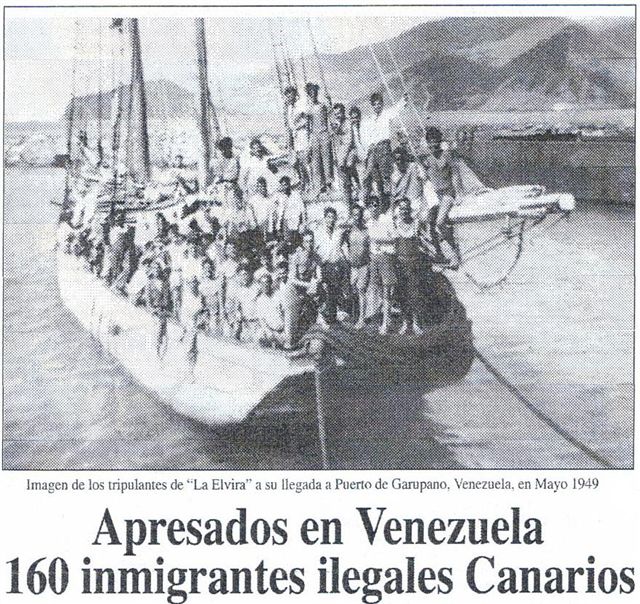
    Of course I cannot dare to speak for the local reaction on the ground in the Canary islands where most of the starved and shocked illegal immigrants are found drifting off their coast. However when I look at the 1949 photo above I am most struck by the extent to which fortunes have changed. It is as recent as the 1940´s and 1950´s that 1 in every 3 inhabitants of the very same Canary Islands emigrated to Venezuela and 1 in 5 Galicians were heading for Argentina, Cuba, Switzerland and Germany.

    Some have argued that this is all in the past and that we should not make decisions by looking backwards in time. Perhaps they are right. Perhaps they need not look backwards at all for they need only look northwards to the towns of Avión where half of the 4730 voters live abroad, and Concello Va do Dubra where 40% of the 7318 voters live overseas. I shall say no more.

    Thursday, August 31, 2006


    Barcelona - Too many questions

    Up until recently, the very mention of “Barcelona” would send my mind jumping from the image of Freddy Mercury singing with a fat lady at a fountain, to random names such George Orwell, Linford Christie and some punter known as Gaudi, before it would finally settle on a curious club policy of sponsor-free football jerseys.

    However now that I have visited the city on numerous occasions and my streams of consciousness take a very different route, I regret to say that Barcelona still seems as far away from me as before. The truth is that while I can recognise that it is more European and cosmopolitan than any other Spanish city, I continue to wait for Barcelona to reveal itself to me. So what is it that keeps passing me by? I feel somewhat embarrassed and under qualified to write about this, Spain’s second city, as I sense that almost everyone grasps the essence of the Catalan capital except for yours truly. Indeed given that I find myself in the clear minority for quite some time now, I am inclined to think that the problem is me and not Barcelona. But even so, my dilemma remains the same…. do I love the city or do I hate it?

    Founded in 230 B.C by a Carthaginian, Barcelona boasts an existence of well over 1000 years before Moors built a fortress in 900 A.D which would in time become Madrid. Still and all in addition to an older heritage and a much envied beach, Barcelona is also ostensibly far wealthier than its landlocked rival. In point of fact, looking up at architect Jean Neovel´s latest offering which houses the city water board I am shocked at the money that the city hall has to splash out on such projects. Craning my neck upwards to take in the new Agbar Tower I quickly recalled the common belief that Catalan parliamentary parties keep the eclectic national coalition in power on the condition that Madrid redirect funds originally intended for the underdeveloped, poverty stricken south. That said, I know Spain to be riddled with regional rivalry and bitterness with its Catholic citizens always having coveted their neighbours goods in loud anger. Furthermore the Catalans are proven to be excellent money handlers and blessed with Spain’s only decent sea port whose cranes dangle almost every Spanish import and export conceivable. In light of this, should their opulence really require such conspiracy theories?

    I have long been a supporter of the Catalan drive for federal autonomy and admire the Catalans for how they have brought their language back to life over the last 120 years. This is despite the fact I remain completely in the dark as to what makes you Catalan aside from family origen and place of birth. I keep wondering what it is that makes a Catalan "more" different to every other Spaniard? Nonetheless, regardless of my innocent ignorance I regularly defend all things Catalan to my narrow minded “United Spain” friends. Ironically however, being a red haired Irish man somehow makes me the perfect person for a Catalan to make their political point to. In Barcelona people fail to realise that I don't have say in Spanish politics and I am absolutely no threat to their interests. All I want is to do is spend my money in their vein city, so why insist on speaking Catalan to me when I hear them speaking Castilian to their partners only seconds before!! This for me sums up Barcelona. I arrive there with affection and admiration for its ground breaking architecture, the style of its citizens, the civil war stand against Franco and the city’s perfect geographic location…but then the locals just insist on ruining it all. From my experience to date the friendliest people in Barcelona are Argentine, Irish and Indian but certainly not Catalan. It cannot possibly be so that to be Catalan is merely to be cold, stubborn and good with money.

    Yet despite all of my complaints I still return. Perhaps this is because while my adopted Madrid has very much a village ambience to it, Barcelona has the vibrant city feel which any person including myself will sometimes crave. Like everyone else I love to walk around Barcelona´s narrow streets and get lost between the the tree lined plazas.....in some places even that is enough to find a city´s pulse. I love to sit on the humid terraces and listen to coffee being ordered in the accents of about ten different languages......still no pulse. I go clubbing all night and finish by arguing and laughing with Taxi drivers....but alas the city slips through my fingers once more. I am beginning to believe defeatedly that to enjoy Barcelona I really need to live there. That way I could get under its skin and finally figure out the vibe that eludes me so much. Until I do so, it will continue to be for me the the city that forever disappoints.

    Saturday, July 15, 2006


    Cinema IV


    (see December 2005)

    Argentine

    Iluminados por el Fuego
    Director: Tristán Beaur.
    Story set in the present day in which a 40 year old veteran of the Falklands War remains haunted by his experiences as an eighteen year old conscript fighting in the trenches. Fantastic film.

    Los Diarios de Motocicleta (The motorcycle diaries)
    Director: Walter Salles
    Starring: Gael Garcia
    In 1952 a young medicine student named Ernesto Guevara Lynch heads out on a crucial journey across South America on a tempramental Norton 500 motobike. Filmed in Argentina, Chile and Peru. Great Movie.


    Historias Minimas (Minimal Stories)
    Director: Carlos Sorín
    Three different people from various isolated parts of the Argentine Patagonia embark on three distinct journeys. Recommended to anyone with a curiousity for Argentina.


    El Mundo Grua
    Director: Pablo Trapero
    Excellent movie shot in Black and white. This is the first film by Trapero and in it he uses non professional actors for the principle roles. It is the story of a 50 year old unemployed man who has the opportunity to secure work as a crane operator. Easy to enjoy.

    España

    Volver (Return)
    Pedro Almodovar
    Starring: Penelope Cruz, Carmen Maure, Blanca Portillo, Lola Dueñas.
    Although it only came out this year "Volver" was my very first Almodovar movie. Indeed the perfect introduction to Spains most successful director. Volver as with all of the directors movies has an almost completely female casting and as usual deals with the subject matter of Motherhood and the female struggle. Excellent Soundtrack.

    Todo sobre mi madre (All about my Mother)
    Director: Pedro Almodovar
    Starring: Celia Roth, Penelope Cruz, Carmen Maure, Toni Cantó.
    Certainly ranks abroad as one of the most popular Spanish movies. Typically wacky plot involving transvestites, nuns, drag queens and accidental preganancies. Perfectly explains the iconic status bestowed on Almodovar by one half and the complete disdain by which he is seen by the other.

    Sunday, June 25, 2006

    Classifieds - Ex- Pat style

    The following advertisements feature in the June Classifieds of the two principle English Language Publications of Madrid.

    “The choosy polyglot”
    Spanish Guy from Madrid (28) looking for a girl to interchange Spanish for English, Russian, French, German, Swedish, new friends. If interested write to me to john_madrid..@Yahoo.es

    “The innovator”
    I’m a Spanish boy looking for females interested in learn Spanish with something more than a friend. I think it’s a good form to learn another language. Pentr..@Hotmail.com

    “Patience is a virtue”
    Male Teacher, of English, Wants to meet someone to take advantage, in a fun way, of my language at no extra cost if you are an attractive female with a “Thong”. Waiting4U2@....

    “The Strip Poker Shark”
    Naughty boy looking for naughty girls to play some naughty games. Email me at loveinthebed1970@.... co.uk

    “Where’s my fake tanning lotion and afro wig!?”
    Nice looking Spanish/Latin American Girl looking for hot African-American guys for hip hop dancing and sex without comment. (This is about “tongue exchange”, not language exchange). Must send pic. (I’ll send pic too) boobootylicious@...

    “Not to be trusted”
    Intelligent, Smart, Well Educated good listener young man wants to meet USA/European/Girls to take a coffee, talk, go for a walk, friendship. Not typical immature Spaniard. No games. davidben..@... .es

    “The Question!”
    Spanish Girls Wants A friend, un amigo (30-40, male, hombre) please, be “normal”! por favor alguien normal”! For cinema, talk…. the typical. Hay alguien normal? Is there somebody normal? My number. 605 407…

    “The Answer”
    I am still giving Free English Lessons to women of any age in return for something else, but I don´t want another exchange. Email me at happyteacher24@....